
Why Preparation Alone Doesn't Stop Performance Anxiety
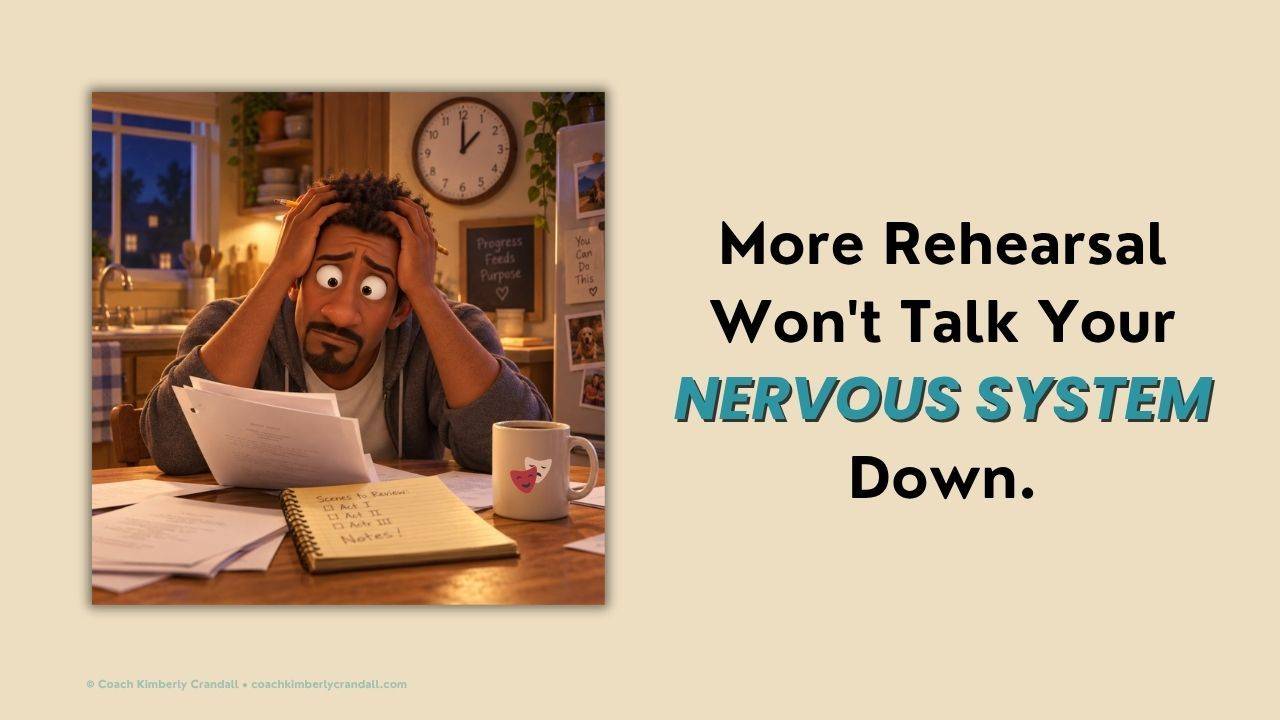
Some actors treat preparation like a dial. Turn it up enough and the nerves are supposed to turn down, so it's one more run of the scene, one more pass at the self-tape, one more read-through before go-time. And still, right when it counts, the heart rate climbs and the breath goes shallow and the body braces like something bigger than the scene is on the line.
This is usually where an actor quietly decides they didn't prepare enough. So they prepare harder. And the anxiety doesn't move, because it was never a preparation problem to begin with.
What Preparation Trains
Preparation is real work, and it matters. It's where an actor builds their choices, locks their blocking, digs into given circumstances, and gets specific about what the character wants and why, and that work happens in the part of the brain that thinks, plans, and problem-solves. It's conscious. It's skill-based, and it's exactly what craft training is for. There's no shortcut around it.
But preparation lives in one system, and performance anxiety lives in another. Rehearsing the scene fifty more times builds the same kind of readiness the first fifty times did. It doesn't touch the system that's actually running the show when the stakes turn real.
What Performance Anxiety Actually Is
Performance anxiety isn't confusion about the material. It's the body's threat response turning on. Under real pressure, the nervous system does exactly what it's built to do, which is prioritize survival over performance, and it doesn't pause to check how many times you rehearsed, how good your choices are, or how ready you actually are. It responds to a sense of being watched, judged, and evaluated the same way it would respond to any other perceived threat, because as far as the body is concerned, that's what's happening.
Preparation happens in the part of you that knows the scene. Performance anxiety happens in the part of you that's scanning for danger. Those are two different systems, and rehearsal only trains one of them.
Why More Rehearsal Doesn't Reach the Layer Underneath
The nervous system doesn't run on logic, it runs on pattern and sensation. If your body has learned, somewhere along the way, that being seen and evaluated equals danger, that alarm is going to fire under pressure no matter how many times you've run the scene in your bedroom where nothing is at stake. You can be word-perfect and still watch your hands shake. You can know exactly what you want in the scene and still feel your throat tighten before you say a single line, and that's not a discipline problem. That's biology doing what biology does. It's also why the words can be right there and still out of reach, which I dug into over here.
This is the layer underneath the craft work, and it's usually the layer nobody trained you to work with. Most actors were taught how to build a character. Almost none were taught how to keep their body online while someone is deciding whether to cast them.
Rehearsed and Regulated Are Not the Same Thing
Being rehearsed means you know your choices, you understand the text, and your blocking is set. Being regulated means your nervous system can stay present and accessible while the stakes are real, and an actor can be completely rehearsed and still not regulated. That gap is exactly where the frustration lives. "I did the work, why do I still feel like this" isn't a sign you're broken. It's a sign you've been training one system and expecting it to cover for the other.
Why This Gets Misread as a Prep Problem
Adding more preparation feels productive because it's something you can control. You can rehearse one more time. You can't will your heart rate down through sheer repetition, so the instinct to over-prepare often isn't really about the material anymore. It's a way of trying to manage a feeling that preparation was never built to reach, and the industry doesn't make this easier, because over-rehearsing gets treated like diligence or the thing that makes actors look lifeless or too planned out and not living in the moment anymore. So the actor who's still anxious after doing everything right tends to assume the fix is more of the same thing that already isn't working. Ugh!
Training the System That's Running the Show
Confidence isn't a personality trait some actors have and others don't. It's a skill, and like any skill it's trainable, but it has to be trained directly. That means learning to work with your nervous system under pressure instead of hoping it settles down on its own. You don't need to eliminate nerves to perform well. You need your system to respond differently when the stakes turn real, so presence is available to you instead of panic.
That's a different kind of training than craft work, and it's part of what I work on with actors one on one inside private training, so preparation and regulation are both getting built, not just one of them.
You're Not Doing It Wrong
If you've done the craft work and the actor anxiety is still there, that doesn't mean you're under-prepared, and it doesn't mean something is wrong with you. It means you've been training the half of the equation that was easiest to see. The good news is the other half is trainable too, and you can rehearse confidence just like you rehearse a scene. It just takes working with the actual system that shows up under pressure, not only the one that memorizes the lines.
Questions Actors Ask About Performance Anxiety
Why do I still get nervous even when I know my lines cold?
Knowing your lines is a craft-level skill. Nerves come from your nervous system's threat response, which runs independently of how well you know the material. You can be fully prepared and still feel anxious, because preparation and regulation are two different things.
Does rehearsing more actually help with audition anxiety?
It helps you get more specific and more confident in your choices, and that's real value. It can help you actually memorize your lines, but even still, those "memorized lines" can disappear in a heartbeat if actor anxiety takes its hold on you. Rehearsal doesn't reduce the nervous system's stress response on its own, which is why actors often feel just as anxious after extra rehearsal as before it.
What's the difference between ordinary nerves and being hijacked by anxiety?
Ordinary nerves are activation. You can still reach your choices and stay present, though holding onto them takes effort that would otherwise be going into the scene. Being hijacked is when that activation takes over, and the body's survival response overrides access to what you've prepared.
Can performance anxiety actually be trained down over time?
Yes. The nervous system responds to training the same way craft does. It takes working directly with how your body responds under pressure, not just rehearsing the material more.
Does this mean preparation doesn't matter?
No, not even for a second. Preparation is essential and it's not optional. The point isn't to prepare less, it's to understand that preparation alone won't reach the nervous system's response to pressure, so it needs its own kind of training alongside your craft work.
Signup to receive industry related insights and tools you don't want to miss!
(No yucky spam - just tips & encouragement to help you on your acting journey!)
🔒100% Secure. I value your privacy and will NEVER share your email. See Privacy Policy to learn your data is protected. Unsubscribe any time.
Secrets From The Set

From Hollywood highs to hilarious lows, I've seen it all and I'm sharing the real deal from 24+ years in the biz. Let's make your Hollywood dreams reality! Bookmark this bad boy and get ready for a wild ride of effective career boosting tips to enhance & level up your work, auditions, and success!

